

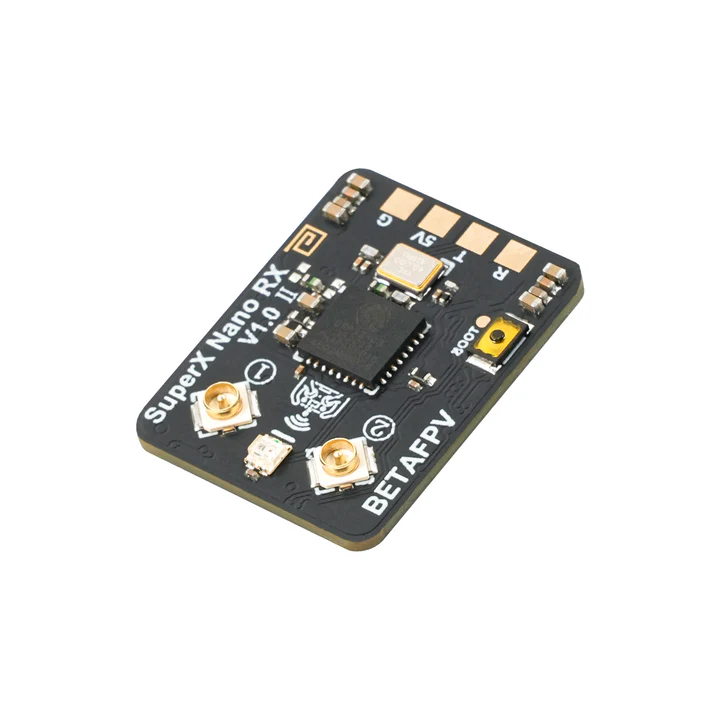
Powered by Semtech’s LR1121 RF chips and Espressif’s ESP32-C3, the SuperX pioneers BETAFPV’s first Gemini Xrossband receiver – mastering 900M (868/915MHz) and 2.4G bands via LoRa and blistering 1000Hz FSK modes. Conquer race gates and long-range horizons with unshakeable signal reliability, where lesser links fail. Choose the dual-band mastery of SuperX Nano or the band-switching agility of SuperX Mono for precision-tuned performance in any flying scenario. Bullet Points Semtech LR1121 RF chips Espressif ESP32-C3 LoRa and blistering 1000Hz FSK modes Supports 900M Gemini, 2.4G Gemini, 900M 2.4G GemX SuperX Nano: Dual-band mastery for RF-challenged environments SuperX Mono: Band-switching for micro builds Works with Micro/Micro V2/Nano V2/SuperG TX modules Compact and lightweight Specifications SuperX Mono RX SuperX Nano RX MCU ESP32-C3 Telemetry Power 20dBm Input Voltage 5V Protocols CRSF, SBUS, SUMD, DJI RS2 Pro, MAVLink RF Chip Single LR1121 Dual LR1121 Reception Mode Single Diversity/Gemini Frequency Band 900M/2.4G 900M 2.4G Antenna Connector U.FL x1 U.FL x2 Weight 0.82g 1.45g Dimensions 12.3 x 18.6mm 16.3 x 21.4mm LUA Name BFPV SuperX Mon BFPV SuperX Nan Recommended 2”- 5” drones (racing, freestyle, long-range) 5” drones (freestyle, photography, long-range) Diagram SuperX Nano Receiver: SuperX Mono Receiver: Gemini ExpressLRS Gemini revolutionizes RC control by leveraging true diversity hardware to simultaneously transmit across 2.4GHz and/or 900MHz frequencies. Unlike conventional systems, Gemini utilizes dual independent transmit/receive chains – delivering superior link quality (LQ) that thrives in challenging environments like race courses or urban areas. Gemini offers three modes: 900M Gemini, 2.4G Gemini, and 900M 2.4G Gemini Xrossband (GemX). With GemX, you no longer need to choose between performance traits—it combines 2.4GHz’s low latency and 900MHz’s long-range in a single, seamless link. Note: The GemX mode requires a dual-band TX. SuperX Nano: 900M 2.4G Dual Band Powered by dual LR1121 chips from Semtech, the SuperX Nano Receiver delivers uncompromising signal reliability with three modes: 900M Gemini (long-range penetration), 2.4G Gemini (ultra-low latency), and 900M 2.4G GemX (simultaneous operation). The included dual-band T antennas eliminate frequency-switching hassles, while advanced diversity processing ensures rock-solid stability in RF-challenged environments. Built for mission-critical applications, it’s the ultimate solution for competitive racers, long-range explorers, and professional aerial photographers who demand zero-compromise performance. SuperX Mono: Band-switching Agility The compact and lightweight SuperX Mono Receiver harnesses a single LR1121 chip with a dual-band antenna, enabling seamless switching between 900M and 2.4G. This cost-effective solution maintains impressive 1000Hz packet rates (in FSK mode) while offering exceptional value, making it ideal for micro builds and budget-conscious pilots who need versatile performance in both close-range freestyle and long-distance applications. TX Compatibility SuperX vs. SuperD vs. Nano SuperX RX SuperD RX Nano RX MCU ESP32-C3 ESP32-PICO-D4 ESP8285 RF Chip Dual LR1121, LR1121 Dual SX128X (2.4G), Dual SX1276 (900M) SX128X (2.4G), SX1276 (900M) Antenna Mode Gemini, single True diversity Single Frequency 900M 2.4G, 900M/2.4G 2.4G/900M Telemetry Power 20dBm 20dBm (2.4G) / 17dBm (900M) Modulation LoRa, FSK LoRa, FLRC Serial Output Protocol CRSF, SBUS, SUMD, DJI RS2 Pro, MAVLink BETAFPV ExpressLRS Receivers Choosing the right receiver is critical for optimal FPV performance. BETAFPV’s ExpressLRS lineup offers tailored solutions for every pilot: ELRS Lite, Micro, Nano, SuperP, SuperD, and the newest SuperX. From whoop racing to long-range cinematography, we engineer the low-latency links and interference-proof performance you demand. Configuration The SuperX Receiver currently supports CRSF/SBUS/SUMD protocols. The following takes CRSF protocol as an example to introduce its connection and pin configuration with Betaflight firmware flight controller. Wiring diagram: JST SH connector pin configuration: Note: Betaflight and ExpressLRS use different JST SH connector pin configurations. Betaflight: 5V (V ), GND, RX, TX; ExpressLRS: GND, 5V (V ), TX, RX. When using the terminal wires for connection, please check the sequence. Connect the flight controller to the Betaflight Configurator for basic configuration. First, on the “Port” tab, enable the flight controller serial port like UART1 as Serial Rx. On the “Configuration” tab, set Receiver Mode to Serial (via UART) and Serial Receiver Provider to CRSF. Bind The SuperX Receiver uses ExpressLRS V3.x official protocol as its default firmware without a pre-set binding phrase. For successful operation, ensure the transmitter module also uses ExpressLRS V3.x or later firmware with no pre-set binding phrase. Power-cycle the receiver 3 times with a 1-second interval or press and hold the BOOT button for 2 seconds to enter binding mode. The RGB indicator flashes orange twice, which indicates the receiver is in bind mode. Configure remote control or transmitter module to bind with the receiver. If the RGB indicator is a solid light, it’s bound! Notes: After binding once, the receiver will remember the autosaved binding phrase and device. Further restarting of the device will be bound automatically without the need for a rebinding process. If you have flashed firmware to the SuperX and configured the binding phrase, you will not be able to bind using the method above. Please set the same binding phrase for the transmitter module, this allows the receiver to be bound to the device automatically. It is recommended to place the two antennas as far apart as possible for better reception. Know More About ExpressLRS ExpressLRS is an open-source RC link for RC applications. Everyone could find this project on Github or join the discussion in Facebook Group. File User Manual for BETAFPV SuperX ELRS Gemini Xross Receiver Firmware for SuperX ELRS Gemini Xross Receiver How to flash the firmware of SuperX Receiver via Passthrough or WIFI? To minimize GPS interference when using 868MHz, X150, or LowBand packet rates, avoid setting the telemetry ratio to 1:2 unless absolutely necessary—especially at 100mW telemetry power. If you require MAVLink or a 1:2 telemetry ratio, please position the SuperX receiver as far as possible from the GPS and avoid pointing the receiver antenna toward the GPS during satellite acquisition. Package Item: SuperX ELRS Gemini Xross Receiver – Nano 1* SuperX Nano Receiver 2* Dual-band T Antenna 1* SH1.0 Connector (Double Ended) 2* Heat Shrink Tubing 1* User Manual Item: SuperX ELRS Gemini Xross Receiver – Mono 1* SuperX Mono Receiver 1* Dual-band T Antenna 1* SH1.0 Connector (Single Ended) 2* Heat Shrink Tubing 1* User Manual
También te recomendamos…
-
 NEW ARRIVAL
ER5A V2 2.4GHz ELRS PWM Receiver
Seleccionar opciones Este producto tiene múltiples variantes. Las opciones se pueden elegir en la página de producto -
 NEW ARRIVAL
HGLRC HAMMER 5.8G 5dBi MINI ANTENNA SMA NO WIRE
Seleccionar opciones Este producto tiene múltiples variantes. Las opciones se pueden elegir en la página de producto -
ER5A V2 2.4GHz ELRS PWM Receiver
Seleccionar opciones Este producto tiene múltiples variantes. Las opciones se pueden elegir en la página de producto
Productos relacionados
-
NEW ARRIVAL
HGLRC HAMMER 5.8G 5dBi MINI ANTENNA SMA NO WIRE
Seleccionar opciones Este producto tiene múltiples variantes. Las opciones se pueden elegir en la página de producto -
NEW ARRIVAL
ER5A V2 2.4GHz ELRS PWM Receiver
Seleccionar opciones Este producto tiene múltiples variantes. Las opciones se pueden elegir en la página de producto -
NEW ARRIVAL
HGLRC HAMMER 5.8G 5dBi MINI ANTENNA SMA NO WIRE
Seleccionar opciones Este producto tiene múltiples variantes. Las opciones se pueden elegir en la página de producto -
NEW ARRIVAL
ER5A V2 2.4GHz ELRS PWM Receiver
Seleccionar opciones Este producto tiene múltiples variantes. Las opciones se pueden elegir en la página de producto